
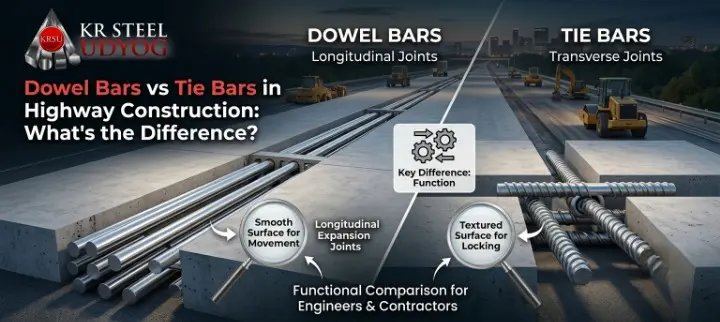
The use of dowel bars and tie bars in concrete road construction is important in maintaining structural pavement performance in the modern era of concrete road construction. They are designed for different applications in highway pavement joints, however, and should never be substituted for one another. Engineers, contractors, and procurement teams can use the information about dowel bars vs tie bars to make well-informed choices for long-lasting roads. As a trusted dowel bar manufacturer in West Bengal with MTC certificate, KR STEEL UDYOG supplies certified steel solutions for infrastructure projects across India. To find the best galvanized steel dowel bars airport taxiway supplier India, you need to be familiar with the product’s use.
What Are Dowel Bars?
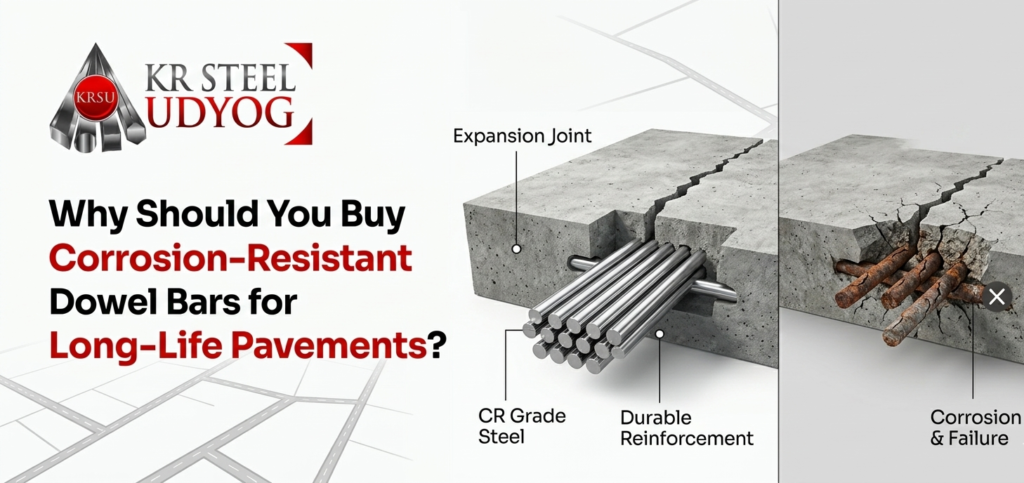
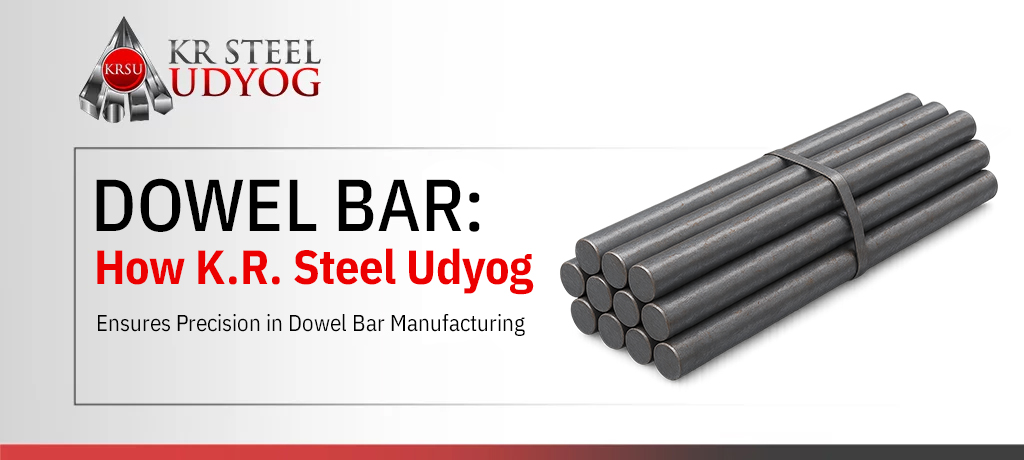
The concrete pavements are smooth expansion joint steel bars that extend across the transverse joint dowel bars locations. They are primarily used for pavement load transfer between adjacent slabs, but permit horizontal slab movement due to temperature change.
Benefits include:
- Improved load transfer efficiency
- Improved alignment of concrete slabs
- Reduced joint stress
- Enhanced pavement durability
- Effective pavement faulting prevention
Dowel Bars are commonly used in highways, airports and heavy-duty industrial pavements.
What Are Tie Bars?
Longitudinal joints tie bar applications make use of tie bars that are deformed steel bars. They are not transfer load devices like dowel bars. Rather, these retain the side slabs against each other and prevent them from separating.
Their functions include:
- Controlling slab movement
- Supporting pavement cracking prevention
- Maintaining lane stability
- Improving joint integrity
The bars are often used on multi-lane roads and in paved urban environments.
Dowel Bars vs Tie Bars: Key Differences
| Feature | Dowel Bars | Tie Bars |
| Surface | Smooth | Deformed |
| Purpose | Load transfer | Slab restraint |
| Joint Type | Transverse | Longitudinal |
| Movement | Allows movement | Restricts movement |
| Function | Supports wheel loads | Prevents separation |
| Application | Highways, airports | Traffic lanes |
Where Are Dowel Bars Used?
Dowel bars are used in the following:
- Airport pavement construction
- National highways
- Expressways
- Bridge approach pavement
- Logistics parks
- Heavy-duty industrial roads
Today, many projects opt for epoxy-coated dowel bars and corrosion-resistant dowel bars are being preferred today.
Where Are Tie Bars Used?
Tie bars are most commonly found:
- Multi-lane highways
- Urban roads
- Concrete streets
- Parking areas
- Service roads
They ensure uniformity of adjacent lanes and enhance pavement stability.
Why Dowel Bars Are Critical in Highway Construction?
Wheel load transfer is greatly dependent on dowel bars. Since efficient dowel systems were shown to reduce joint distress and maintenance in concrete pavements dramatically.
Major benefits include:
- Better load distribution
- Reduced slab deflection
- Improved road performance
- Lower maintenance costs
- Increased pavement lifespan
Allows them to be necessary highway construction materials, and important pavement engineering material.
Can Dowel Bars Replace Tie Bars?
No. Tie bars and dowel bars have totally different engineering functions. Slab separation may be prevented using tie bars, and movement may be achieved using dowel bars. Replacing one bar with another may compromise concrete road joints and overall pavement performance.
MORTH Recommendations for Dowel Bars and Tie Bars
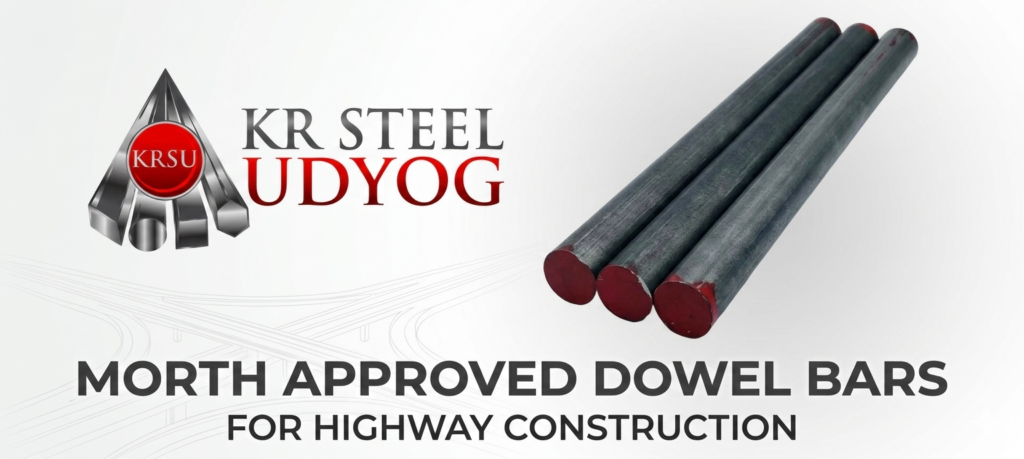
Major highway projects require the installation of MORTH-approved dowel bars to meet requirements for dimensions, coating requirements, and material standards as per road construction standards.
Buyers should verify:
- Material certification
- Dimensional accuracy
- Corrosion protection
- MTC availability
- Meeting of project requirements
What Should Buyers Check Before Purchasing?
Buyers should check before purchasing steel bars for pavements:
- Product quality
- Manufacturing consistency
- Coating performance
- Certification documents
- Supplier reliability
- Bulk supply capabilities
Our Experience
At KR STEEL UDYOG, we have provided Infrastructure Steel products for transportation infrastructure and Industrial Road construction projects across India.
From our experience:
- Certified products improve project compliance.
- Correctly installed dowel bars help to extend pavement life.
- Solutions that are less prone to corrosion require less maintenance.
- Airport and highway projects demand strict quality control.
- MTC certified products give consumers more confidence.
- If pavement joint designs are correct, a pavement will provide long service.
- Contractors avoid delays in projects by having reliable supply chains.
FAQs
Can dowel bars prevent pavement faulting?
Yes, they improve load transfer and minimise faulting risks.
Are MORTH-approved dowel bars necessary?
They are recommended for use in highway and infrastructure projects.
Why choose MTC-certified dowel bars?
They guarantee quality, traceability and standards.